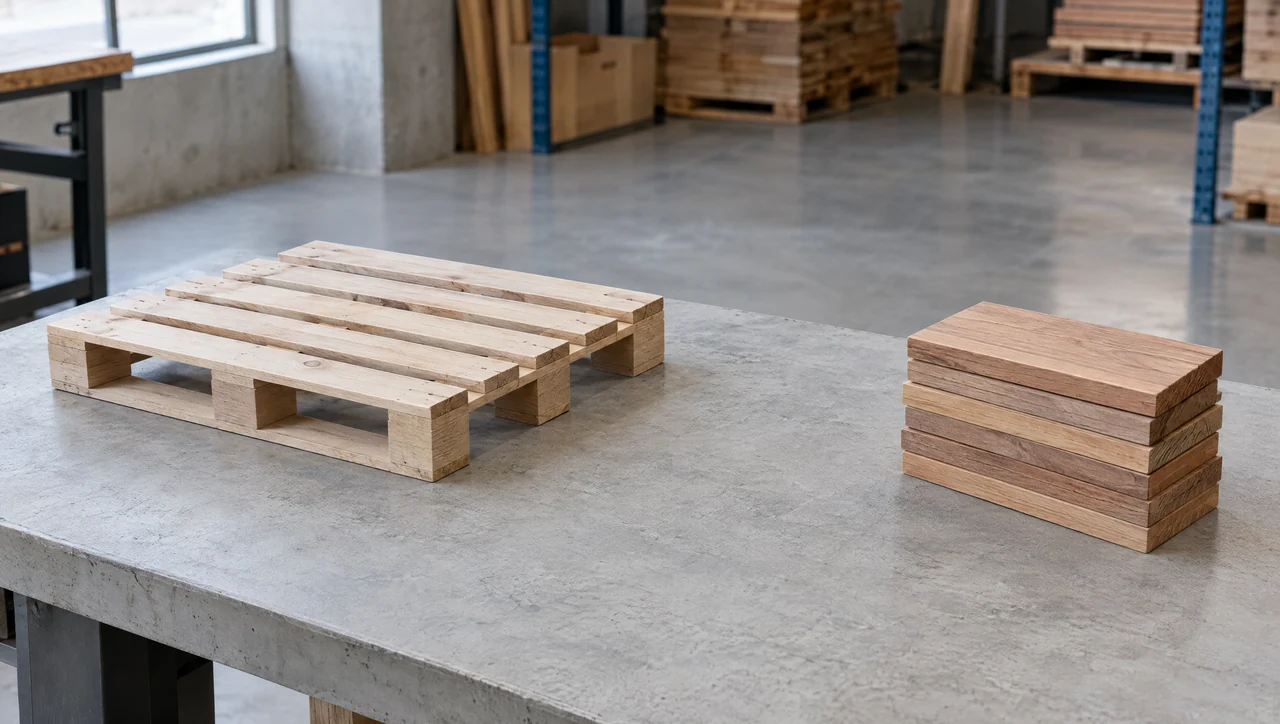
Illustrative concept: considering the container and lumber as separate components.
Illustrative weight-planning context. No scale reading, density or measured moisture content is supplied by the image.Gross mass includes contents and packaging. Tare is the packaging or container portion; define exactly what each label includes in your record.
- 01Net lumber
- 02Plus documented tare
- 03Estimated gross
Name what is included
A number labeled lumber weight may omit the pallet, protective wrapping, separators and other materials traveling with it. Before comparing that number with a shipment record, ask what each includes. The same words can be used casually for different scopes, so the component list matters.
Use a dedicated packaging line instead of hiding tare in the density. Changing the wood density to make a total match a freight record destroys the traceability of both inputs. Keep measured tare and assumed tare visibly different.
One package versus a shipment
For several packages, identify tare for each package and any shared handling materials. Do not multiply an already-total packaging figure by the number of bundles. If a container is weighed separately, retain the container reference and condition so a later deduction uses a comparable basis.
The bundle tool accepts an explicit total tare in pounds. An empty field should not be interpreted as a verified zero; record whether packaging is absent, excluded or still unknown. The exported record describes the figure as an estimate unless an actual measurement has been documented elsewhere.
Worked discrepancy check
Suppose the lumber worksheet says 600 lb and a supplier gives 650 lb for the packaged quantity. The 50 lb difference could be packaging, different board counts, dimensions, condition or measurement scope. Do not automatically declare it to be pallet weight.
Reconcile one component at a time: count, section, lengths, density basis and packaging. Keep the source dates with the corrected record. A useful estimate supports that conversation; it should not override an appropriately documented weighing merely because the spreadsheet has more decimal places.
VISUAL FIELD NOTE · WORKED EXAMPLE
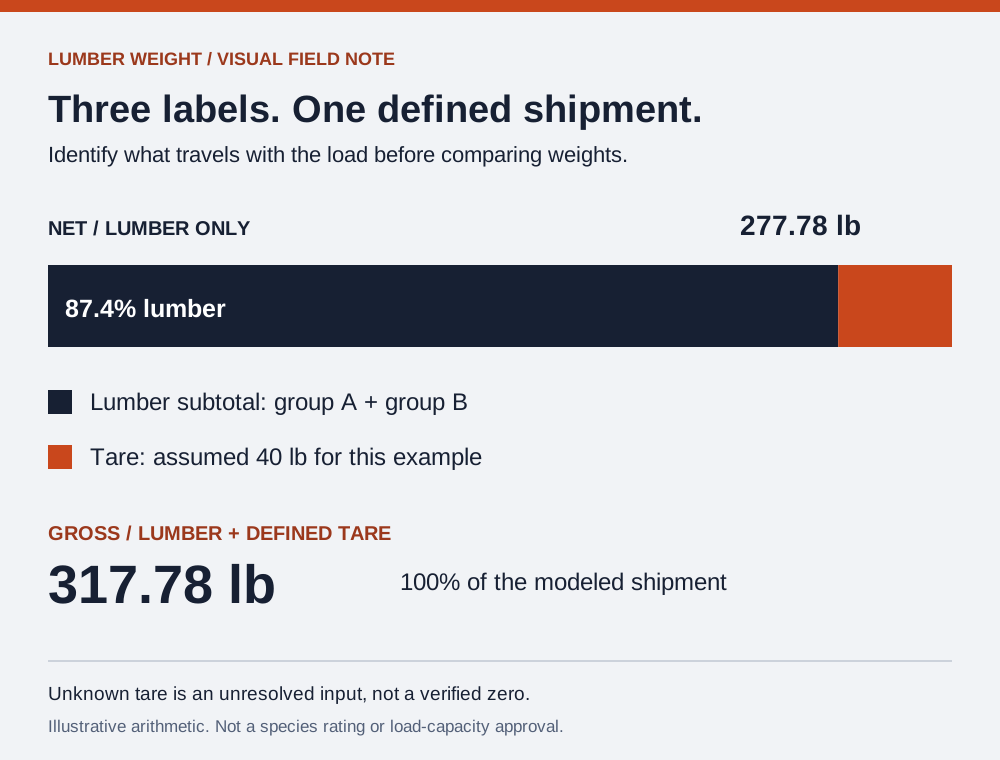
See what net, tare and gross include
The visual separates the lumber portion from a stated packaging allowance.
Read the numbers and text explanation
- Net
- 277.78 lb of lumber in the modeled quantity
- Tare
- 40 lb of assumed packaging
- Gross
- 317.78 lb for the combined scope
- Share of total
- Lumber: 87.4%; packaging: 12.6%, rounded
Reconcile the lumber estimate with the shipment
Net lumber mass, packaging mass and the measured shipment total answer different questions. Label each number before comparing it. A calculator based on board volume and density estimates the lumber under the stated assumptions; it does not weigh the pallet, straps, wrapping or other cargo.
In this arithmetic example, a shipment weighs 1,240 kg and the separately established packaging mass is 85 kg. Subtraction gives 1,155 kg for the remaining contents. That can be called net lumber mass only if the contents are exclusively the lumber being reconciled and both measurements use a consistent basis. An undocumented tare estimate should stay labelled as an estimate.
If the calculator predicted 1,100 kg, the 55 kg difference is a prompt to check quantity, dimensions, density condition, packaging and measurement records. It is not proof that any one input was wrong. Keep the original estimate so the investigation can identify which assumptions changed.
Keep the three quantities separate
| Quantity | Example | Basis |
|---|---|---|
| Gross shipment | 1,240 kg | Recorded total mass |
| Tare | 85 kg | Separately established packaging mass |
| Remaining contents | 1,155 kg | Gross minus tare |
| Calculated lumber estimate | 1,100 kg | Volume and selected density |
| Difference to investigate | 55 kg | Remaining contents minus estimate |
Neither the estimate nor this subtraction establishes a vehicle, lifting or handling capacity. Use the applicable equipment information and responsible operator’s loading assessment. Keep units visible on every exported value.
Evidence & scope
This field note provides an original planning workflow and illustrative arithmetic. It does not publish measured product properties or prescribe operating limits.