Calculate both endpoints using the same geometry. A chosen range is a scenario, not a statistical guarantee or maximum possible weight.
- 01Fixed quantity
- 02Low / high assumption
- 03Two explicit results
Choose a range for a stated reason
A range should come from documented variation, several relevant measurements or an explicitly exploratory assumption. Record which it is. Combining the lowest number from one unrelated reference with the highest from another can create a range with no coherent moisture or product basis.
Use the same count, dimensions and packaging scope for both calculations when isolating density uncertainty. If several inputs change at once, label the result as a combined scenario rather than attributing the difference to one property.
Worked sensitivity example
For an illustrative 8 cubic feet, assumptions of 40 and 50 lb/ft³ produce 320 and 400 lb. The 80 lb spread comes entirely from the selected density inputs. It does not establish that the real quantity must fall between those figures.
With density fixed, a 5% change in solid volume produces a 5% change in modeled lumber mass. This proportional relationship can help decide whether better dimension measurements or better density information would most improve the estimate. It does not identify the actual error in either input.
Report the uncertainty honestly
Attach the endpoints, units and reasons to the record. Avoid titles such as guaranteed maximum unless a responsible source actually provides and supports that claim. An engineering or handling decision may require a different conservative method determined by the responsible professional.
When better evidence arrives, update the input and preserve the previous scenario as context. A range is useful when it guides the next information request, not when it disguises the absence of product data.
VISUAL FIELD NOTE · WORKED EXAMPLE
Make density uncertainty visible
An input range changes the estimate even when every dimension and count stays the same.
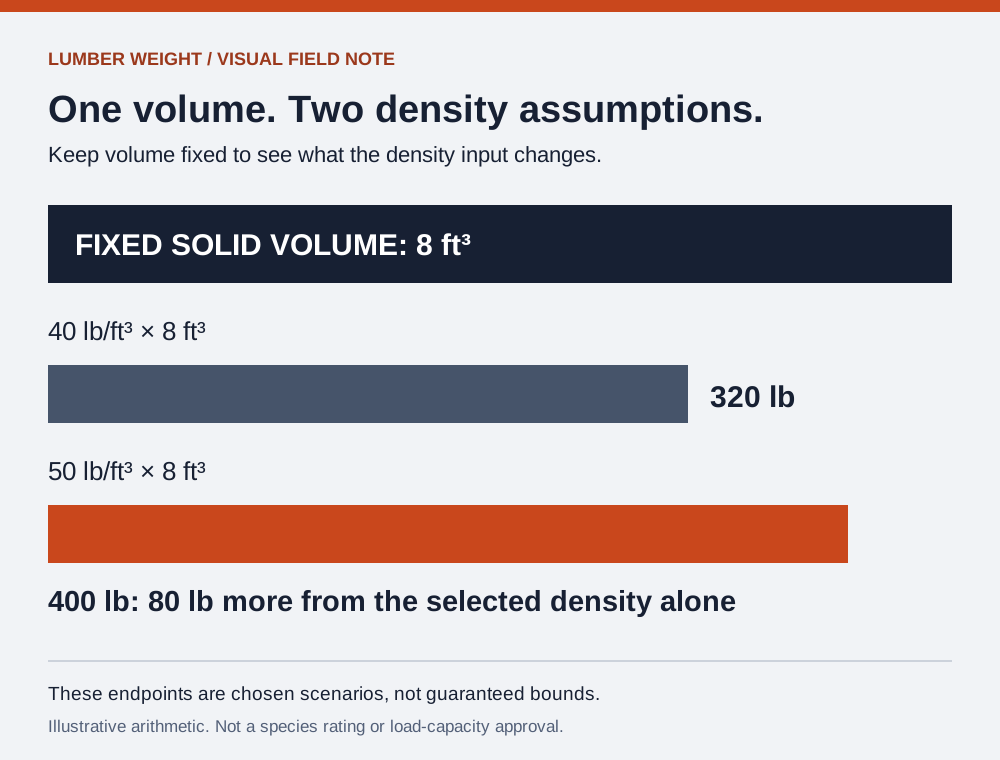
Read the numbers and text explanation
- Fixed volume
- 8 ft³ of modeled solid lumber
- Lower selected density
- 40 lb/ft³ × 8 ft³ = 320 lb
- Higher selected density
- 50 lb/ft³ × 8 ft³ = 400 lb
- Scenario spread
- 80 lb, or 25% above the lower scenario
Evidence & scope
This field note provides an original planning workflow and illustrative arithmetic. It does not publish measured product properties or prescribe operating limits.
Read the editorial policy