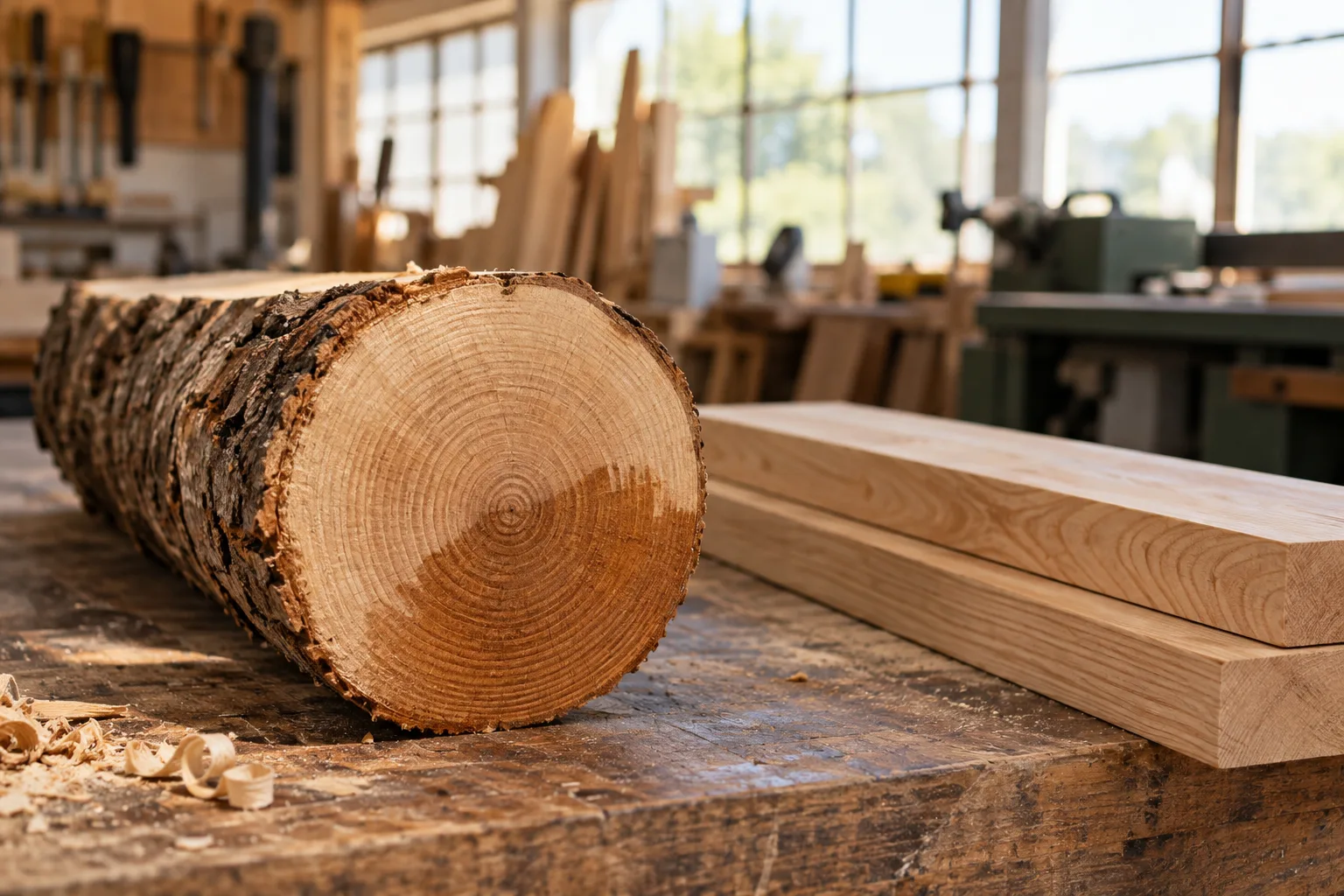
Compare the same dry material at two documented moisture contents. Do not assume every green or dried board shares one standard weight.
- 01Same dry material
- 02Initial condition
- 03Target scenario
Define what stays the same
A meaningful moisture comparison follows the same wood material. If the second quantity has been surfaced or cut, some dry material may also have been removed. A difference between two scale readings could reflect both water change and changed geometry. Record those operations before attributing the entire difference to drying.
Separate the initial mass and moisture basis from the target scenario. The target is an input, not a forecast. The calculator cannot establish whether the wood will reach that condition, how long it will take or whether it will be suitable for installation.
Worked example: a mass scenario
Suppose an illustrative 120 kg quantity is at 20% dry-basis moisture content. Its inferred dry mass is 120 ÷ 1.20 = 100 kg. At a hypothetical 10% target, the model gives 110 kg. The 10 kg difference is not 10% of the original 120 kg.
Both moisture values are assumptions in this example. A real record needs compatible measurement information. For mixed bundles with different starting conditions, calculate appropriate groups separately rather than applying one convenient label to the whole delivery.
Keep density and geometry consistent
Changing a density input while keeping the original dimensions may describe a different model from tracking the same piece through moisture change. The mass scenario intentionally avoids predicting volume change. Choose the model that matches the question, and do not combine the results as if they were independent corrections.
For a supplier inquiry, ask for information about the proposed shipping condition. A general species article can explain why moisture matters but cannot determine the mass of a particular pack.
VISUAL FIELD NOTE · WORKED EXAMPLE
Understand moisture without changing the denominator
Both bars contain the same 100 kg of oven-dry material. Only the water portion changes.
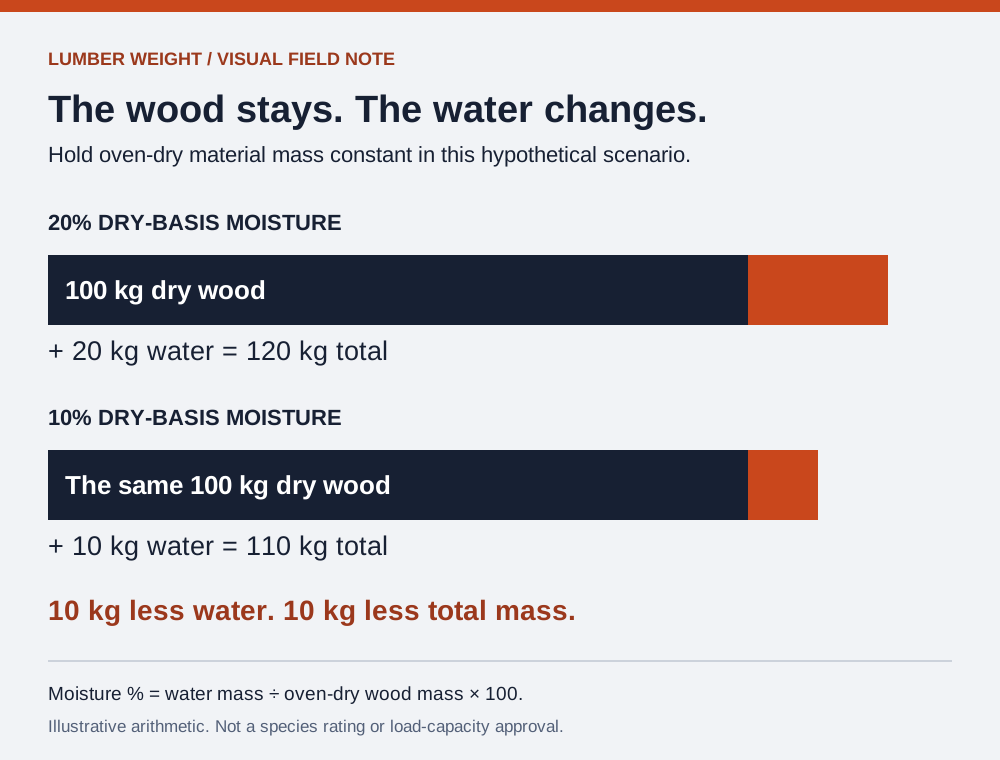
Read the numbers and text explanation
- Initial scenario
- 20 kg water ÷ 100 kg dry wood = 20% moisture; total mass 120 kg
- Target scenario
- 10 kg water ÷ 100 kg dry wood = 10% moisture; total mass 110 kg
- Difference
- 10 kg less water and 10 kg less total mass
- The incorrect shortcut
- Subtracting 10% of 120 kg gives 108 kg, which uses the wrong denominator
Evidence & scope
Wood–water relationships and physical properties. General reference, not a supplied-product weight certificate.