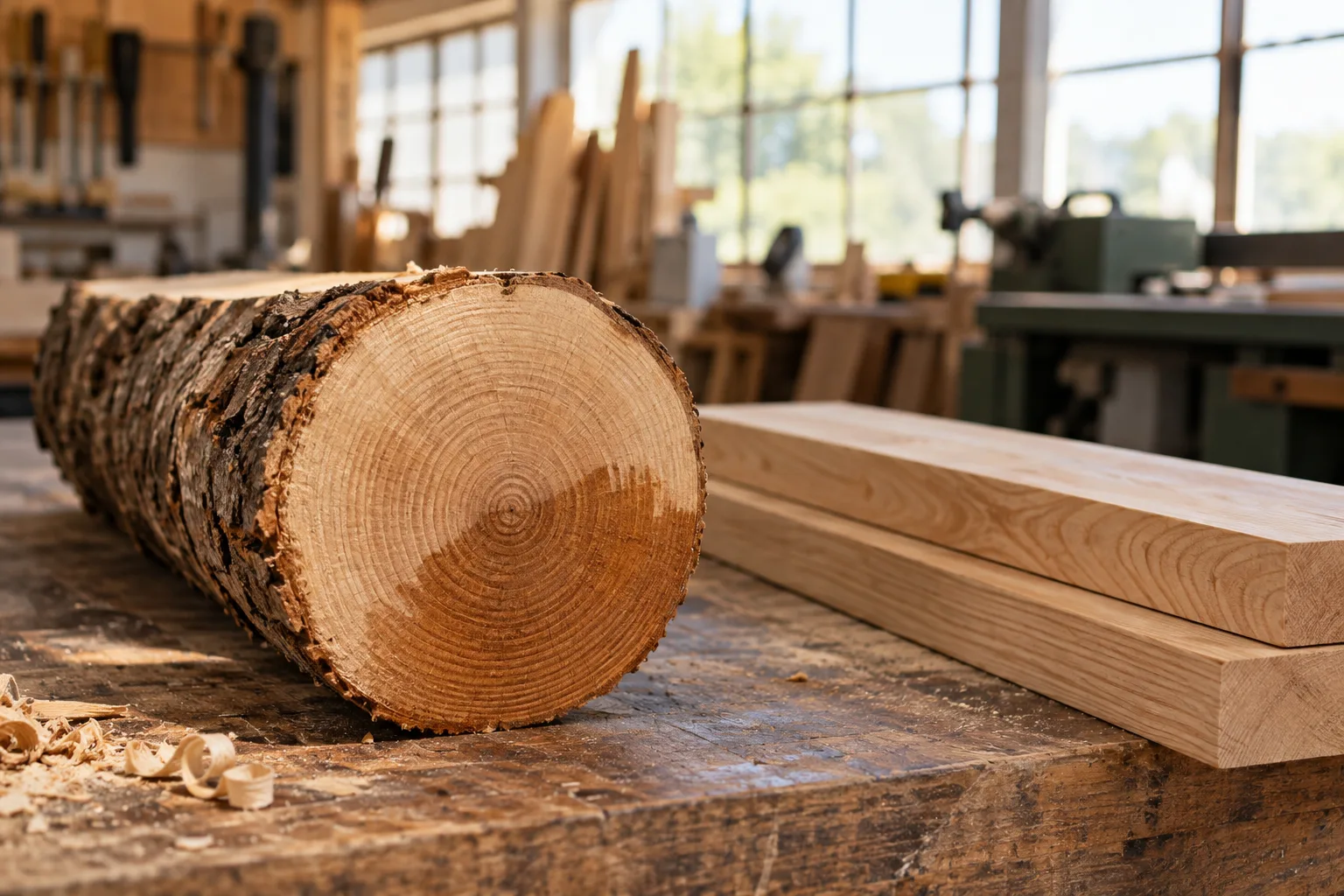
Dry-basis moisture content compares water mass with oven-dry wood mass. It is not the percentage of the current wet mass that is water.
- 01Oven-dry wood mass
- 02Water mass
- 03Current total mass
The denominator changes the meaning
In the dry-basis convention, moisture content is water mass divided by oven-dry wood mass, multiplied by 100. A hypothetical piece with 10 kg of dry wood and 2 kg of water has 20% dry-basis moisture content and 12 kg total mass. Water is one-sixth of that current mass, not one-fifth.
This distinction matters when estimating the effect of a moisture change. Subtracting the stated moisture percentage directly from the wet mass uses the wrong denominator. The site’s scenario tool first estimates the dry mass, then calculates the target total under a constant-dry-mass assumption.
A product label does not supply a measurement
Green, air-dried and kiln-dried describe conditions or processes, but they do not provide a current measured moisture value for every piece. Request the relevant specification or measurement record when the calculation depends on one. Include the method, date and sampled material.
The USDA handbook describes wood’s exchange of moisture with its environment. That is why a previously reported condition and a current shipping condition may differ. This reference does not predict drying time, equilibrium at your site or installation readiness.
Document the scenario limits
The mass-change tool assumes the same dry material remains present. Cutting, decay, treatment uptake, coatings, packaging changes and material loss can break that assumption. The tool does not calculate shrinkage, drying stresses or future dimensions.
Use the output to explore a stated what-if question. If a final dispatch mass is required, confirm how the material will be weighed or documented rather than treating the moisture scenario as a substitute for that process.
VISUAL FIELD NOTE · WORKED EXAMPLE
Understand moisture without changing the denominator
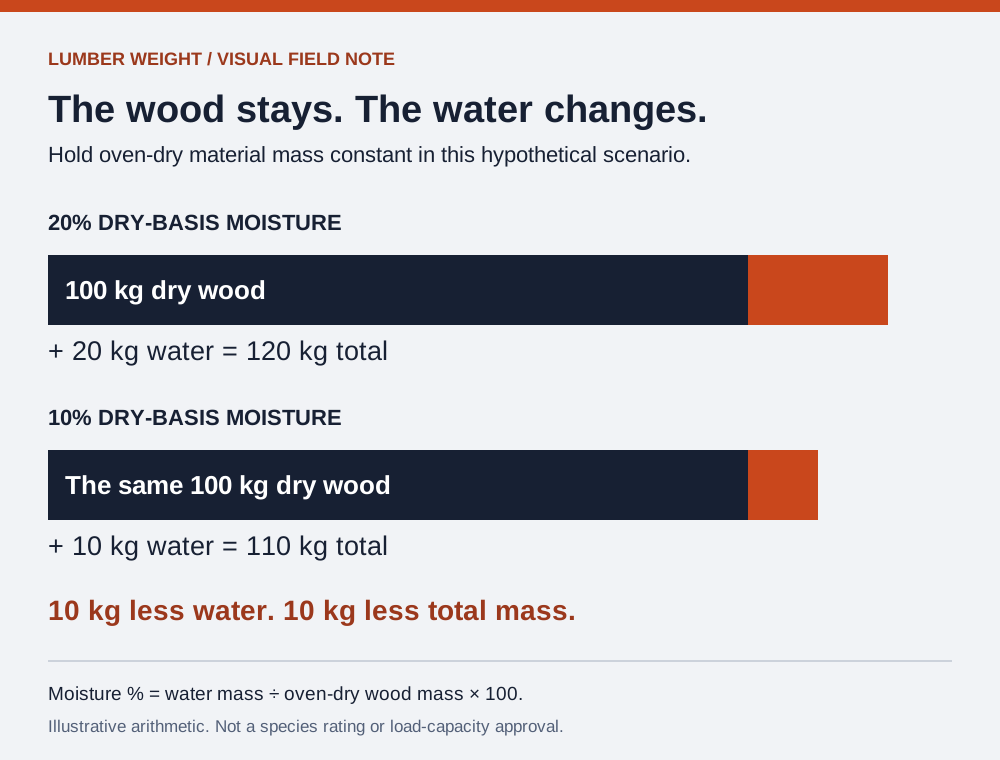
Both bars contain the same 100 kg of oven-dry material. Only the water portion changes.
Read the numbers and text explanation
- Initial scenario
- 20 kg water ÷ 100 kg dry wood = 20% moisture; total mass 120 kg
- Target scenario
- 10 kg water ÷ 100 kg dry wood = 10% moisture; total mass 110 kg
- Difference
- 10 kg less water and 10 kg less total mass
- The incorrect shortcut
- Subtracting 10% of 120 kg gives 108 kg, which uses the wrong denominator
Evidence & scope
Wood–water relationships and physical properties. General reference, not a supplied-product weight certificate.