LUMBER WEIGHT REFERENCE
Moisture change mass calculator
Explore the same dry material at two dry-basis moisture contents. No drying-time or volume prediction.
Target scenario · -10 kg change
Inferred oven-dry mass: 100 kg. Target water mass: 10 kg.
Assumes constant dry material mass. No cutting, treatment uptake, coatings, losses, packaging, shrinkage or drying-time prediction. Switching the unit relabels the entered mass; it does not convert it.
Why the percentage is not simply subtracted
Dry mass = initial mass ÷ (1 + initial MC / 100). Target mass = dry mass × (1 + target MC / 100). Moisture content uses dry wood mass as its denominator.
VISUAL FIELD NOTE · WORKED EXAMPLE
Understand moisture without changing the denominator
Both bars contain the same 100 kg of oven-dry material. Only the water portion changes.
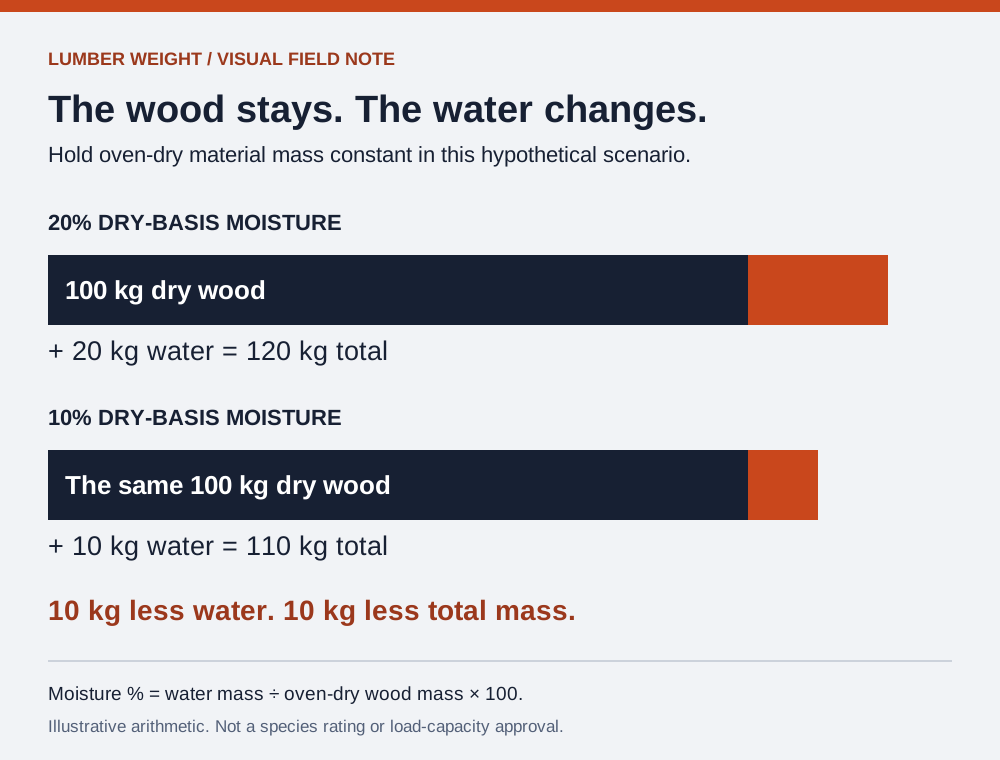
Read the numbers and text explanation
- Initial scenario
- 20 kg water ÷ 100 kg dry wood = 20% moisture; total mass 120 kg
- Target scenario
- 10 kg water ÷ 100 kg dry wood = 10% moisture; total mass 110 kg
- Difference
- 10 kg less water and 10 kg less total mass
- The incorrect shortcut
- Subtracting 10% of 120 kg gives 108 kg, which uses the wrong denominator
Moisture
What moisture basis means on a weight record
Read dry-basis moisture content correctly and separate a measured condition from a drying label.
Open resource ↗Moisture
Green and dry lumber: compare conditions, not labels
Understand the inputs needed before estimating how a change in moisture affects the weight of the same wood.
Open resource ↗Density & evidence
Density and specific gravity are different inputs
Understand why a dimensionless specific-gravity entry cannot simply be typed into a pounds-per-cubic-foot field.
Open resource ↗